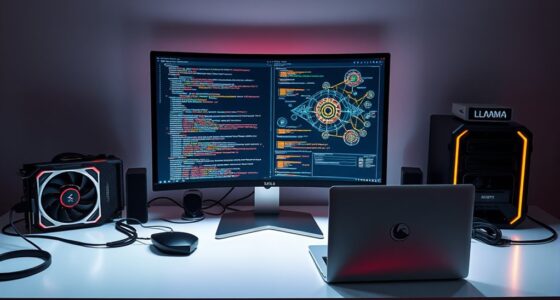
Emerging AI hardware alternatives like quantum accelerators and neuromorphic chips are challenging the traditional GPU dominance. These specialized solutions offer faster, more efficient processing for complex tasks such as optimization, simulation, and sensory data analysis. They provide better power efficiency and adaptability for various AI workloads. As these technologies develop, they could reshape the AI ecosystem. If you explore further, you’ll discover how these innovations could transform AI computing landscapes and open new possibilities.

Get movie nights delivered free — and shop member deals
- Fast, free delivery on millions of items
- Access to Prime Big Deal Days deals on October 6–7
- Prime Video, Amazon Music and more included
Key Takeaways
- Quantum accelerators offer exponential speedups for specific AI tasks like optimization and simulation.
- Neuromorphic chips mimic brain structures, enabling energy-efficient, real-time pattern recognition.
- Specialized hardware such as ASICs and FPGAs provide optimized solutions beyond traditional GPUs.
- Increasing heterogeneity in AI hardware allows task-specific, high-performance, and energy-efficient processing.
- These emerging technologies challenge GPU dominance, fostering innovation and diversification in AI hardware development.
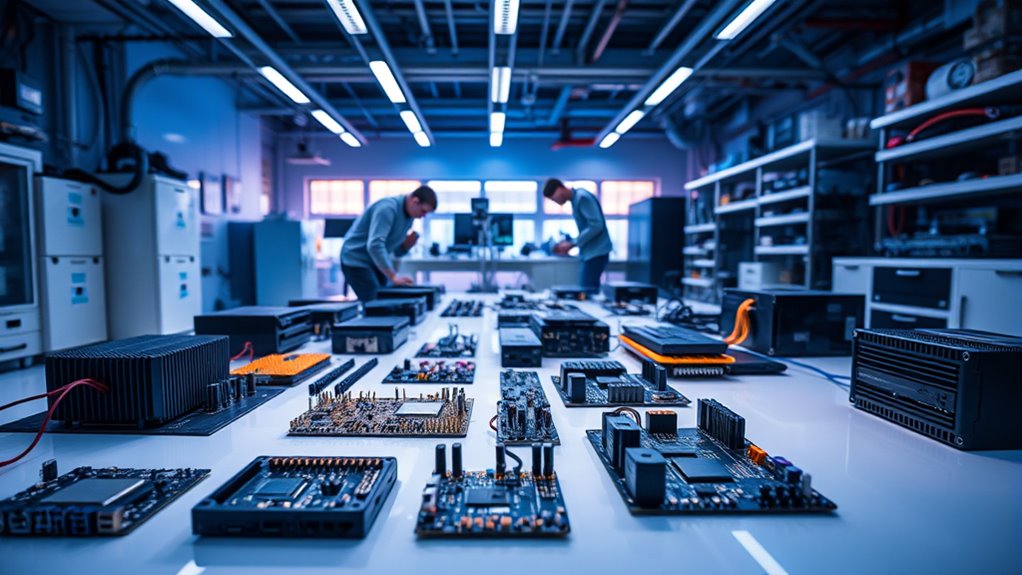
As artificial intelligence continues to advance, researchers and developers are exploring new hardware alternatives beyond traditional GPUs and TPUs. The dominance of GPUs in AI processing is undeniable, but the demand for more efficient, powerful, and specialized hardware has sparked interest in emerging technologies like quantum accelerators and neuromorphic chips. These innovations promise to reshape how you approach AI workloads, offering potential breakthroughs in speed, energy efficiency, and adaptability.
Quantum accelerators stand out because they leverage quantum mechanics to perform certain computations exponentially faster than classical hardware. Unlike GPUs, which excel at parallel processing of large datasets, quantum accelerators target specific problems like optimization, simulation, and cryptography—tasks integral to advanced AI models. As quantum hardware matures, you might find these accelerators integrated into AI pipelines, accelerating complex computations that are currently time-consuming or infeasible. They could enable new levels of machine learning, particularly in areas requiring massive combinatorial searches or probabilistic reasoning, where classical hardware hits limitations. While quantum technology is still in its infancy, ongoing research hints at a future where quantum accelerators complement or even replace traditional chips for specialized AI tasks, breaking the GPU monopoly and offering a paradigm shift in processing capabilities.
On the other hand, neuromorphic chips mimic the structure and function of the human brain’s neural networks. Unlike GPUs, which process data in a highly parallel but digital manner, neuromorphic hardware operates using spiking neurons and synaptic connections, enabling it to learn and adapt more naturally. If you’re working on real-time processing, robotics, or edge computing, neuromorphic chips could offer significant advantages in power consumption and latency. These chips are designed to be highly efficient at pattern recognition, sensory data processing, and decision-making tasks—areas where traditional hardware often struggles with power efficiency or speed. By embracing neuromorphic architectures, you can develop AI systems that learn continually, adapt to new data, and operate seamlessly in environments where traditional chips might falter.
Both quantum accelerators and neuromorphic chips challenge the long-held GPU dominance by providing specialized, potentially more efficient solutions tailored to different aspects of AI. They represent a shift from a one-size-fits-all approach to a diversified hardware landscape, where you choose the right tool for the task. As these technologies mature, expect to see a more heterogeneous AI hardware ecosystem, giving you greater flexibility, improved performance, and energy savings. This evolution not only disrupts the GPU monopoly but also encourages innovation, pushing AI research into new frontiers and opening doors to applications previously constrained by hardware limitations. Additionally, the integration of cybersecurity measures into emerging AI hardware will be crucial to protect these advanced systems from potential threats as they become more widespread.
Frequently Asked Questions
How Do New AI Hardware Options Compare in Performance to GPUS?
New AI hardware options often excel in hardware efficiency, offering faster processing with less power consumption compared to traditional GPUs. They also tackle scalability challenges better, allowing you to expand your AI infrastructure more easily. While some may still lag in raw performance, these alternatives provide a balanced mix of speed, efficiency, and scalability, making them promising options for future AI development.
What Are the Cost Differences Between Emerging AI Hardware and Traditional GPUS?
The cost comparison shows emerging AI hardware can be a revitalizing change, often offering better hardware affordability than traditional GPUs. While initial prices may vary, many alternatives are designed to reduce expenses over time, especially for large-scale projects. You’ll find that these new options can help you save money, making AI development more accessible without sacrificing performance, and breaking the GPU’s costly grip on the market.
How Accessible Are These Alternative AI Hardware Solutions for Small Businesses?
You can access alternative AI hardware solutions more easily than you might think, especially as market entry barriers lower. Many options are now designed with user accessibility in mind, featuring user-friendly setups and all-encompassing support. Small businesses can leverage these emerging alternatives without extensive technical expertise, making it feasible to integrate advanced AI hardware into your operations. This increased accessibility helps you stay competitive in the rapidly evolving AI landscape.
What Is the Environmental Impact of Adopting New AI Hardware Technologies?
Imagine your AI hardware as a garden; greener choices mean less watering and fewer weeds. Adopting new AI hardware technologies can reduce your environmental impact by promoting sustainable manufacturing and lowering lifecycle environmental impact. These innovations often use energy more efficiently and incorporate eco-friendly materials, helping you minimize carbon footprints. You’ll contribute to a sustainable future while enjoying powerful performance—think of it as cultivating a healthier, more resilient garden for generations to come.
How Quickly Can These Alternatives Be Integrated Into Existing AI Workflows?
You can incorporate these AI hardware alternatives relatively quickly, depending on your software compatibility and integration complexity. If your existing workflows are flexible and well-documented, adoption may take just a few weeks. However, more complex systems could require several months to guarantee seamless integration, testing, and optimization. Staying updated on hardware support and collaborating with vendors can accelerate this process and minimize disruptions.
Conclusion
As you watch the landscape shift, it’s like witnessing a new dawn breaking through the clouds, revealing fresh paths beyond the GPU monopoly. These emerging AI hardware options quietly blossom, promising to reshape your future projects. Just as the morning sun pierces the darkness, innovation sparks hope for more accessible, diverse, and powerful solutions. Keep your eyes open—you might find yourself walking through a whole new world of possibilities, where the old gives way to the extraordinary.
Evergreen bestsellers Picks
bestsellers
As an affiliate, we earn on qualifying purchases.