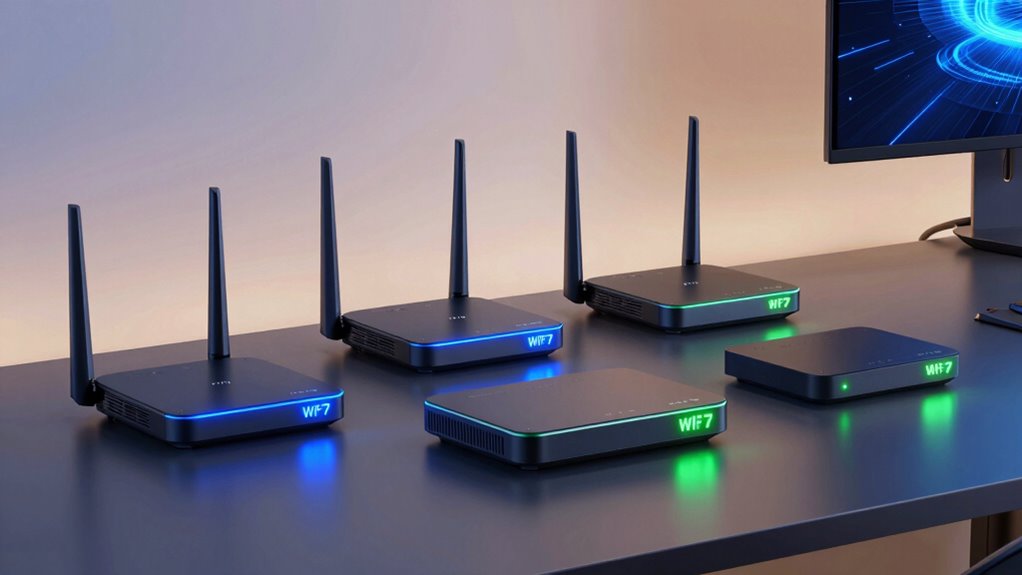

If you’re searching for a wifi 7 router, you’re looking at the latest in wireless technology designed for faster speeds, broader coverage, and more reliable connections. The TP-Link Archer BE600 stands out as the best overall choice, offering a solid mix of speed and security. For those prioritizing mesh coverage, the eero Max 7 provides excellent range and device capacity. Meanwhile, gamers and power users may prefer the ASUS ROG Rapture GT-BE98 Pro with its quad-band setup and high throughput. Tradeoffs in this category often involve balancing coverage, speed, ease of setup, and price. Continue reading for the full breakdown to find the perfect match for your network needs.
Key Takeaways
- The best routers combine high throughput, extensive coverage, and device capacity, but often require higher investment.
- Mesh systems like the eero Max 7 excel in coverage and device handling, ideal for large homes or tech-heavy households.
- Advanced features such as multi-band configurations and multi-Gig ports are common in premium models but add complexity and cost.
- User needs vary: gamers benefit from high throughput and gaming-specific features, while casual users prioritize ease of setup and coverage.
- Price often correlates with features; understanding your specific needs helps avoid overpaying for unnecessary tech.
| TP-Link Tri-Band WiFi 7 Router (Archer BE600) with 10G Port and HomeShield Security |  | Best Overall for Large Homes and Gaming | WiFi Technology: WiFi 7 | Max Speed: 5,765 Mbps on 6 GHz, 2,882 Mbps on 5 GHz, 1,032 Mbps on 2.4 GHz | Coverage: Up to 2,600 sq. ft. | VIEW ON AMAZON | See Our Full Breakdown |
| eero Pro 6E Mesh Wi-Fi Router – Supports internet plans up to 2.5 Gbps, Coverage up to 2,000 sq. ft., Connect 100+ devices, 1-pack |  | Best for Simplicity and Expandability | Wi-Fi Standard: Wi-Fi 6E | Max Speed: 2.3 Gbps | Coverage: 2000 sq. ft. | VIEW ON AMAZON | See Our Full Breakdown |
| TP-Link Dual-Band Wi-Fi 7 Router Archer BE230, 4-Stream, 2.5G Ports, USB 3.0, Quad Core, 4 Antennas, Mesh Support |  | Best for High-Speed Streaming and Gaming | Wi-Fi Technology: Wi-Fi 7 | Speed: Up to 2882 Mbps (5 GHz), 688 Mbps (2.4 GHz) | Ports: 1×2.5G WAN/LAN, 1×2.5G LAN, 3×1G LAN, USB 3.0 | VIEW ON AMAZON | See Our Full Breakdown |
| eero Max 7 Mesh Wi-Fi Router (Newest Model) – Supports Internet Plans up to 10 Gbps, Coverage up to 2,500 sq. ft., Connects 250+ Devices |  | Best for Ultra-High-Speed, Large-Scale Smart Homes | Ethernet Ports: 2 x 10 Gigabit | Wireless Speed: up to 4.3 Gbps | Coverage: 2,500 sq. ft. | VIEW ON AMAZON | See Our Full Breakdown |
| TP-Link Tri-Band WiFi 7 Router (Archer BE550) – 6-Stream, 2.5G Ports, EasyMesh, VPN |  | Best for High-Speed, Future-Proof Home Networking | WiFi Bands: Tri-Band | Max Speed: 5760 Mbps (6 GHz), 2880 Mbps (5 GHz), 574 Mbps (2.4 GHz) | Ports: 1×2.5G WAN, 4×2.5G LAN | VIEW ON AMAZON | See Our Full Breakdown |
| eero 7 Dual-Band Mesh Wi-Fi 7 Router – Supports Internet Plans up to 2.5 Gbps, Coverage up to 2,000 sq. ft., 1-Pack |  | Best for Easy Expansion and Reliable Coverage | Wi-Fi Technology: Wi-Fi 7 | Coverage: 2,000 sq. ft. | Internet Support: up to 2.5 Gbps | VIEW ON AMAZON | See Our Full Breakdown |
| TP-Link Archer BE12000 Tri-Band Wi-Fi 7 Router with 6GHz Band and 10G Connectivity |  | Best for Power Users and Large Homes | Wi-Fi Bands: Tri-band (6 GHz, 5 GHz, 2.4 GHz) | Maximum Speed: Up to 5,765 Mbps (6 GHz), 5,765 Mbps (5 GHz), 688 Mbps (2.4 GHz) | Ports: 10 Gbps WAN/LAN, 2.5 Gbps WAN/LAN, three 1 Gbps LAN, USB 3.0 | VIEW ON AMAZON | See Our Full Breakdown |
| TP-Link BE6500 Dual-Band WiFi 7 Router (BE400) with 2.5Gbps Ports, USB 3.0, Covers 2,400 sq. ft., Supports 90 Devices |  | Best for Reliable Coverage and Security in Large Homes | Wi-Fi Technology: Wi-Fi 7 | Max Coverage: 2,400 sq. ft. | Device Capacity: 90 devices | VIEW ON AMAZON | See Our Full Breakdown |
| NETGEAR Nighthawk Dual-Band WiFi 7 Router (RS140) |  | Best for Gaming and Streaming on a Budget | WiFi Generation: WiFi 7 | Speed: up to 5.0 Gbps | Coverage: 2,250 sq. ft. | VIEW ON AMAZON | See Our Full Breakdown |
| NETGEAR Nighthawk Dual-Band WiFi 7 Router (RS90) |  | Best for Compact, High-Speed Home Networks | Wi-Fi Speed: up to 3.6 Gbps | Coverage: 2000 sq. ft. | Device Support: Moderate | VIEW ON AMAZON | See Our Full Breakdown |
| ASUS ROG Rapture GT-BE98 Pro WiFi 7 Gaming Router – Quad-Band, 30Gbps, Mesh |  | Best Overall for Gamers and Power Users | WiFi Standard: WiFi 7 (802.11be) | Max Speed: 30 Gbps | Bands: Quad-Band | VIEW ON AMAZON | See Our Full Breakdown |
| TP-Link Deco 7 Pro BE63 Tri-Band WiFi 7 Mesh System (3-Pack) |  | Best for Whole-Home Coverage and Ease of Use | Coverage: 7,600 sq.ft. | Number of Units: 3 | WiFi Bands: Tri-band WiFi 7 | VIEW ON AMAZON | See Our Full Breakdown |
| wifi 7 router | Coverage | Ports |
|---|---|---|
| TP-Link Tri-Band WiFi 7 Router | Up to 2,600 sq. ft. | 1x 10 Gbps WAN/LAN, 1x 2.5 Gbps WAN/LAN, 3x 2.5 Gbps LAN |
| eero Pro 6E Mesh Wi-Fi Router | 2000 sq. ft. | — |
| TP-Link Dual-Band Wi-Fi 7 Rout | Up to 2000 sq. ft. | 1×2.5G WAN/LAN, 1×2.5G LAN, 3×1G LAN, USB 3.0 |
| eero Max 7 Mesh Wi-Fi Router | 2,500 sq. ft. | — |
| TP-Link Tri-Band WiFi 7 Router | Up to 2,000 sq. ft. | 1×2.5G WAN, 4×2.5G LAN |
| eero 7 Dual-Band Mesh Wi-Fi 7 | 2,000 sq. ft. | 2 auto-sensing 2.5 GbE ports |
| TP-Link Archer BE12000 Tri-Ban | Up to 3,000 sq. ft. | 10 Gbps WAN/LAN, 2.5 Gbps WAN/LAN, three 1 Gbps LAN, USB 3.0 |
| TP-Link BE6500 Dual-Band WiFi | — | 1x 2.5 Gbps WAN/LAN, 1x 2.5 Gbps LAN, 3x 1 Gbps LAN |
| NETGEAR Nighthawk Dual-Band Wi | 2,250 sq. ft. | 4 Ethernet, 2.5 Gbps WAN |
| NETGEAR Nighthawk Dual-Band Wi | 2000 sq. ft. | 4 Ethernet, 2.5 Gbps WAN |
| ASUS ROG Rapture GT-BE98 Pro W | — | — |
| TP-Link Deco 7 Pro BE63 Tri-Ba | 7,600 sq.ft. | 4x 2.5G WAN/LAN, 1 USB 3.0 |
More Details on Our Top Picks
TP-Link Tri-Band WiFi 7 Router (Archer BE600) with 10G Port and HomeShield Security
This model stands out for its impressive combination of high speeds, extensive coverage, and multi-gig ports, making it well-suited for demanding gaming setups and large households. Compared with the eero Max 7, it offers superior wired connectivity with 10G ports, but the setup process can be intimidating for non-technical users. The Archer BE600’s tri-band WiFi 7 supports up to 120 devices, ensuring stable connections even in busy environments. Its security features, including HomeShield, add peace of mind. However, its size and complexity mean it might be less appealing for those seeking simplicity or a smaller form factor. For users who prioritize top-tier performance and robust security in a large home, this pick delivers.
Pros:- High-speed WiFi 7 performance supporting demanding applications
- Extensive coverage of up to 2,600 sq. ft. and 120 devices
- Multi-gig ports for fast wired connections
- Advanced security with HomeShield
Cons:- Complex setup process may intimidate less technical users
- Premium price point may limit affordability
- Large physical size requires ample space
Best for: Large households with gaming, streaming, and smart home devices needing extensive coverage and high-speed wired connections
Not ideal for: Small apartments or less tech-savvy users who prefer straightforward setup and minimal equipment
- WiFi Technology:WiFi 7
- Max Speed:5,765 Mbps on 6 GHz, 2,882 Mbps on 5 GHz, 1,032 Mbps on 2.4 GHz
- Coverage:Up to 2,600 sq. ft.
- Device Capacity:120 devices
- Ports:1x 10 Gbps WAN/LAN, 1x 2.5 Gbps WAN/LAN, 3x 2.5 Gbps LAN
- Security:HomeShield Security, VPN support
Our verdict“Best suited for tech-savvy users with large homes needing robust WiFi 7 performance and security.”
eero Pro 6E Mesh Wi-Fi Router – Supports internet plans up to 2.5 Gbps, Coverage up to 2,000 sq. ft., Connect 100+ devices, 1-pack
The eero Pro 6E offers a straightforward mesh setup ideal for users who want reliable Wi-Fi 6E speeds with minimal fuss. Compared to the TP-Link BE230, it excels in ease of expansion and management through the eero app, making it perfect for households that plan to grow their network gradually. Its coverage up to 2,000 sq. ft. and support for over 100 devices ensure smooth streaming and gaming. While its speeds are slightly lower than the WiFi 7 options, the simplicity and seamless integration often outweigh the performance tradeoff for many consumers. However, it requires a compatible internet plan to reach maximum speeds, and some features need a subscription. This makes it ideal for users prioritizing ease and reliability over raw speed.
Pros:- Simple setup and management via the eero app
- Supports Wi-Fi 6E for faster speeds and lower latency
- Extensive coverage and device support
- Easy to expand with additional units
Cons:- Requires compatible internet plans for maximum speeds
- Subscription needed for advanced security features
- Limited to a single unit in this pack
Best for: Small to medium homes seeking an easy-to-manage, expandable Wi-Fi 6E mesh system
Not ideal for: Power users or large households needing ultra-high speeds and extensive coverage beyond 2,000 sq. ft.
- Wi-Fi Standard:Wi-Fi 6E
- Max Speed:2.3 Gbps
- Coverage:2000 sq. ft.
- Device Support:100+ devices
- Ethernet Ports:1 x 2.5 Gb Ethernet
Our verdict“Ideal for users who want reliable, expandable mesh Wi-Fi with minimal setup effort in medium-sized homes.”
TP-Link Dual-Band Wi-Fi 7 Router Archer BE230, 4-Stream, 2.5G Ports, USB 3.0, Quad Core, 4 Antennas, Mesh Support
The TP-Link Archer BE230 strikes a balance between speed and features, supporting Wi-Fi 7 with speeds up to 2882 Mbps on 5 GHz. Compared with the Archer BE600, it offers fewer multi-gig ports but remains a strong choice for high-performance streaming and gaming. Its quad-core processor and mesh support ensure smooth, whole-home coverage, and the USB 3.0 port adds flexibility. While it lacks the ultra-fast 6 GHz band and extensive security options of premium models, it remains accessible for users seeking fast Wi-Fi without overwhelming complexity. Its performance may vary based on obstacles or environment, and it needs a separate modem. This router fits those who want fast Wi-Fi 7 in a more compact form without sacrificing basic mesh capabilities.
Pros:- Fast Wi-Fi 7 speeds suitable for demanding applications
- Multiple gigabit ports and USB 3.0 for wired flexibility
- Supports mesh for whole-home coverage
- Easy setup with Tether app
Cons:- Performance can be affected by obstacles in the environment
- Requires separate modem for internet connection
- No support for the 6 GHz band
Best for: Gamers and streamers in smaller or medium-sized homes who need fast, reliable Wi-Fi 7 with flexible wired options
Not ideal for: Large homes or users requiring multi-gig wired ports and advanced security features
- Wi-Fi Technology:Wi-Fi 7
- Speed:Up to 2882 Mbps (5 GHz), 688 Mbps (2.4 GHz)
- Ports:1×2.5G WAN/LAN, 1×2.5G LAN, 3×1G LAN, USB 3.0
- Processor:Quad-core 2.0 GHz
- Coverage:Up to 2000 sq. ft.
- Security:HomeShield, VPN, parental controls
Our verdict“Great for users seeking reliable Wi-Fi 7 with good wired options in medium-sized homes or gaming setups.”
eero Max 7 Mesh Wi-Fi Router (Newest Model) – Supports Internet Plans up to 10 Gbps, Coverage up to 2,500 sq. ft., Connects 250+ Devices
The eero Max 7 delivers exceptional wired and wireless speeds, supporting internet plans up to 10 Gbps with extensive coverage for large, interconnected homes. Compared to the TP-Link BE600, it emphasizes mesh scalability and smart home integration, supporting protocols like Thread, Matter, and Zigbee. Its support for over 250 devices and coverage up to 2,500 sq. ft. makes it perfect for heavily connected environments. The setup process is streamlined via the eero app, and its security features, though subscription-based, add a layer of protection. The main tradeoff involves its high price and reliance on subscriptions for full security features. This pick is ideal for users with demanding internet speeds and many smart devices, seeking seamless coverage and future-proofing.
Pros:- Supports ultra-fast wired and wireless speeds
- Extensive coverage and device support
- Smart home protocols compatibility
- Easy setup and management
Cons:- High cost and subscription requirements for full security
- Premium price may be prohibitive for some
- Single-unit purchase limits in this pack
Best for: Large, tech-savvy homes with high-speed internet, numerous smart devices, and a need for scalable mesh coverage
Not ideal for: Small households or budget-conscious users who do not require extensive smart home support or ultra-high speeds
- Ethernet Ports:2 x 10 Gigabit
- Wireless Speed:up to 4.3 Gbps
- Coverage:2,500 sq. ft.
- Device Capacity:250+ devices
- Compatibility:Thread, Matter, Zigbee
- Warranty:3 years
Our verdict“Best suited for large, tech-forward households needing maximum coverage, speed, and smart home integration.”
TP-Link Tri-Band WiFi 7 Router (Archer BE550) – 6-Stream, 2.5G Ports, EasyMesh, VPN
The TP-Link Archer BE550 offers a robust tri-band WiFi 7 experience with speeds up to 5760 Mbps, making it ideal for future-proofing a home network. Compared to the Archer BE230, it provides additional 2.5G ports and EasyMesh support, enabling seamless whole-home coverage. Its security features, including VPN support and HomeShield, add layers of protection, making it appealing for security-conscious users. The full 6 GHz band boosts speeds for demanding applications, but the setup can be complex for users unfamiliar with advanced networking. Also, it requires a modem, and the price isn’t specified, which may be a concern for some. This router works best for those planning to future-proof their network with high-speed, multi-device support, and mesh capabilities.
Pros:- High-speed tri-band WiFi 7 performance
- Full 6 GHz band for maximum speeds
- Multiple 2.5G ports and mesh support
- Robust security features including VPN
Cons:- Setup may be complex for non-technical users
- Requires a separate modem
- Price not specified could be high
Best for: Enthusiasts and gamers who want high-speed, future-ready Wi-Fi with mesh support and security features
Not ideal for: Casual users or those with simple internet needs, who might find the advanced features unnecessary
- WiFi Bands:Tri-Band
- Max Speed:5760 Mbps (6 GHz), 2880 Mbps (5 GHz), 574 Mbps (2.4 GHz)
- Ports:1×2.5G WAN, 4×2.5G LAN
- Antennas:6 internal antennas
- Coverage:Up to 2,000 sq. ft.
- Security:HomeShield, VPN, parental controls
Our verdict“Best for tech-savvy users seeking future-proof, high-speed Wi-Fi with strong security and mesh capabilities.”
eero 7 Dual-Band Mesh Wi-Fi 7 Router – Supports Internet Plans up to 2.5 Gbps, Coverage up to 2,000 sq. ft., 1-Pack
The eero 7 stands out for its simplicity and ease of use, making it ideal for homes that prioritize straightforward setup and reliable coverage. Compared with more complex routers like the TP-Link Archer BE12000, it sacrifices some raw speed for seamless integration into existing eero mesh systems. This pick is perfect for users who want dependable Wi-Fi 7 without diving into advanced configurations, but it might fall short in very large or tech-heavy households that need multiple units to cover expansive spaces efficiently. Its support for over 120 devices and backward compatibility make it a flexible choice for most typical home environments, though it does depend on a compatible internet plan to reach max speeds.
Pros:- Supports Wi-Fi 7 for faster, more reliable internet
- Wide coverage of up to 2,000 sq. ft.
- Supports over 120 devices simultaneously
- Easy to expand and integrate into existing networks
Cons:- Requires compatible internet plan for maximum speed
- Limited to a 1-pack, may need multiple units for larger homes
Best for: Homeowners seeking a simple, expandable Wi-Fi 7 solution with strong coverage and device support
Not ideal for: Tech enthusiasts or large households needing multi-unit mesh setups or ultra-high speeds beyond 2.5 Gbps
- Wi-Fi Technology:Wi-Fi 7
- Coverage:2,000 sq. ft.
- Internet Support:up to 2.5 Gbps
- Ports:2 auto-sensing 2.5 GbE ports
- Device Capacity:120+ devices
- Compatibility:Backward compatible with previous eero models
Our verdict“This router is best for users who want reliable, straightforward Wi-Fi 7 coverage with easy expandability.”
TP-Link Archer BE12000 Tri-Band Wi-Fi 7 Router with 6GHz Band and 10G Connectivity
The TP-Link Archer BE12000 excels in high-end performance, combining tri-band Wi-Fi 7 with a 6GHz band and multiple high-speed ports, including 10G Ethernet, making it ideal for demanding households with extensive device networks. Unlike the eero 7, which is more plug-and-play, this router targets advanced users who need maximum throughput and extensive wired options. The tradeoff is its complexity; setup and management can be daunting for less experienced users, and it’s not compatible with some mesh systems like Deco. Nonetheless, it provides a robust platform for streaming, gaming, and smart home devices, especially in large or tech-heavy homes where speed and connectivity are critical.
Pros:- Supports latest Wi-Fi 7 technology, including 6GHz band
- Multiple high-speed ports including 10G and 2.5G for versatile wired connections
- Wide coverage for large homes
- Advanced security and device management features
Cons:- Complex setup may overwhelm casual users
- Not compatible with some mesh systems like Deco
- Price is likely high, no exact figure provided
Best for: Tech-savvy homeowners with large, device-rich environments needing ultra-fast, multi-gig wired and wireless connectivity
Not ideal for: Casual users or small apartments where simplicity and affordability matter more than maximum performance
- Wi-Fi Bands:Tri-band (6 GHz, 5 GHz, 2.4 GHz)
- Maximum Speed:Up to 5,765 Mbps (6 GHz), 5,765 Mbps (5 GHz), 688 Mbps (2.4 GHz)
- Ports:10 Gbps WAN/LAN, 2.5 Gbps WAN/LAN, three 1 Gbps LAN, USB 3.0
- Coverage:Up to 3,000 sq. ft.
- Antennas:6 high-gain antennas
- Compatibility:Works with Alexa, Google Assistant, all WiFi providers
Our verdict“This router suits users demanding top-tier speed and wired connectivity, prepared to handle complex network setups.”
TP-Link BE6500 Dual-Band WiFi 7 Router (BE400) with 2.5Gbps Ports, USB 3.0, Covers 2,400 sq. ft., Supports 90 Devices
The TP-Link BE6500 provides a balanced mix of speed, coverage, and security, making it suitable for large homes that need dependable Wi-Fi 7 without excessive complexity. Compared with the NETGEAR RS140, which offers slightly lower coverage, the BE6500’s emphasis on multi-gig ports and security features like WPA3 makes it attractive for busy households with many smart devices. Its straightforward setup and robust security, including HomeShield, appeal to users who want peace of mind along with fast internet. The main tradeoff is that its features may feel overwhelming for casual users, and it requires compatible Wi-Fi 7 devices to fully leverage its speeds.
Pros:- Supports Wi-Fi 7 with high-speed, reliable performance
- Covers up to 2,400 sq. ft., suitable for large homes
- Multiple 2.5 Gbps ports and USB 3.0 for wired devices
- Advanced security with WPA3 and HomeShield
Cons:- Features might be overwhelming for casual users
- Higher price point compared to older models
- Requires compatible Wi-Fi 7 devices to maximize speed
Best for: Families seeking a secure, high-performance Wi-Fi 7 router that covers large areas with multiple wired options
Not ideal for: Users with small apartments or those looking for ultra-minimalist setups, due to its feature set and price
- Wi-Fi Technology:Wi-Fi 7
- Max Coverage:2,400 sq. ft.
- Device Capacity:90 devices
- Ports:1x 2.5 Gbps WAN/LAN, 1x 2.5 Gbps LAN, 3x 1 Gbps LAN
- Security:HomeShield, WPA3
- Dimensions:10.6 x 6 x 1.9 inches
Our verdict“Ideal for families prioritizing security and coverage in a Wi-Fi 7 router with straightforward setup.”
NETGEAR Nighthawk Dual-Band WiFi 7 Router (RS140)
The NETGEAR Nighthawk RS140 delivers impressive dual-band Wi-Fi 7 speeds up to 5.0 Gbps, making it a solid choice for gamers and streamers who want reliable performance without the complexity of tri-band setups. Unlike the TP-Link BE12000, which offers extensive wired ports and tri-band options, the RS140 keeps things simpler but still supports a substantial 2,250 sq. ft. coverage area and up to 80 devices. Its support for a 2.5 Gig internet port ensures fast multi-gig plans are usable, though it doesn’t offer the multi-band flexibility of higher-end models. This makes it a good middle ground for users who prioritize speed but don’t need the most advanced features.
Pros:- Fast Wi-Fi 7 speeds up to 5.0 Gbps for smooth gaming and streaming
- Supports up to 80 devices across 2,250 sq. ft.
- Includes 2.5 Gbps port for multi-gig internet plans
- Simpler dual-band setup suitable for most users
Cons:- Limited to dual-band Wi-Fi, missing tri-band benefits
- Requires a separate modem for internet access
- Coverage may be less in larger or multi-story homes
Best for: Gamers and streamers seeking high-speed Wi-Fi 7 performance at a more accessible price point
Not ideal for: Large households or those requiring extensive wired connections and tri-band flexibility
- WiFi Generation:WiFi 7
- Speed:up to 5.0 Gbps
- Coverage:2,250 sq. ft.
- Number of Devices Supported:80
- Ports:4 Ethernet, 2.5 Gbps WAN
- Security Protocol:WPA3
Our verdict“This router offers strong Wi-Fi 7 speed and coverage for gamers and streamers on a budget, without extra complexity.”
NETGEAR Nighthawk Dual-Band WiFi 7 Router (RS90)
The NETGEAR Nighthawk RS90 offers a compact dual-band Wi-Fi 7 solution that balances speed and coverage, making it suited for smaller homes or apartments. While it supports speeds up to 3.6 Gbps and covers about 2,000 sq. ft., it doesn’t match the higher maximum speeds of tri-band options like the BE12000. Its four Gigabit LAN ports and 2.5 Gbps WAN port provide ample wired connectivity for most setups, and its security features such as WPA3 and NETGEAR Armor add peace of mind. Compared with larger routers, its smaller form factor and straightforward features make it attractive for users with moderate needs who value space-saving design, though it may struggle in larger or multi-story homes where coverage could be limited.
Pros:- High-speed Wi-Fi 7 performance up to 3.6 Gbps
- Supports guest WiFi and WPA3 security
- Compact design suitable for small spaces
- Includes 2.5 Gbps WAN port and four Gigabit LAN ports
Cons:- Limited coverage compared to larger models
- Dual-band only, missing tri-band advantages
- Would benefit from additional units in larger homes
Best for: Urban dwellers or small households requiring a compact, high-speed Wi-Fi 7 router
Not ideal for: Larger homes or users with extensive wired networking needs
- Wi-Fi Speed:up to 3.6 Gbps
- Coverage:2000 sq. ft.
- Device Support:Moderate
- Ports:4 Ethernet, 2.5 Gbps WAN
- Security:WPA3, NETGEAR Armor
- Size:Compact
Our verdict“A fitting choice for small spaces needing fast, reliable Wi-Fi 7 without bulk or excessive features.”
ASUS ROG Rapture GT-BE98 Pro WiFi 7 Gaming Router – Quad-Band, 30Gbps, Mesh
The ASUS ROG Rapture GT-BE98 Pro stands out for delivering incredible speeds up to 30 Gbps with WiFi 7, making it ideal for demanding gaming and high-bandwidth tasks. Its quad-band configuration and external dual-feeding antennas provide superior coverage and low latency, outperforming many tri-band options like the TP-Link Deco 7 Pro in speed and responsiveness. However, its advanced features and multiple ports come with a complex setup, which may challenge less tech-savvy users, and the premium price makes it less accessible for casual users. This router is best suited for gamers, streamers, or tech enthusiasts seeking top-tier performance without compromise. Compared to alternatives like the TP-Link Deco 7 Pro, it prioritizes raw speed and gaming optimization over simplicity and affordability.Pros:- Supports WiFi 7 with up to 30 Gbps speeds for demanding applications
- External dual-feeding antennas enhance coverage and signal strength
- Multiple high-speed wired ports (1x 10G, 3x 2.5G) for versatile connectivity
- Optimized for gaming with multi-link operation and game acceleration
Cons:- Setup can be complex for less technical users
- Premium price tag may be prohibitive for budget-conscious buyers
Best for: High-performance gamers, streamers, and tech-savvy home users needing maximum speed and low latency.
Not ideal for: Casual users or families looking for a straightforward setup at a lower cost, due to its complexity and premium price.
- WiFi Standard:WiFi 7 (802.11be)
- Max Speed:30 Gbps
- Bands:Quad-Band
- Antennas:External dual-feeding antennas
- Wired Ports:1x 10G, 3x 2.5G
- Features:Multi-link Operation, Game Acceleration
Our verdict“This router is an excellent choice for users who prioritize top performance and gaming features over ease of setup and cost.”
TP-Link Deco 7 Pro BE63 Tri-Band WiFi 7 Mesh System (3-Pack)
The TP-Link Deco 7 Pro BE63 excels in providing broad coverage, up to 7,600 sq.ft., with a 3-pack designed to blanket large homes with fast WiFi 7, supporting over 200 devices simultaneously. Its tri-band setup and AI-driven seamless roaming make it a strong choice for households needing reliable connectivity across multiple floors, outperforming many single-router options like the Archer BE600 in coverage and device capacity. While it requires a separate modem and may experience performance fluctuations due to environmental factors, its setup via the Deco app is straightforward, making it accessible even for less tech-savvy users. This system is ideal for large families or shared spaces where stable, extensive coverage is a priority. Compared to the ASUS ROG Rapture, it sacrifices some raw speed for simplicity and extensive range, making it more suitable for everyday use and multi-device households.Pros:- Extensive coverage up to 7,600 sq.ft. with 3 units
- Supports high-speed WiFi 7 with multiple device connections
- Includes wired ports (4x 2.5G WAN/LAN) for future-proofing
- AI-driven seamless roaming ensures stable connections across large areas
Cons:- Requires a separate modem for internet service
- Performance can vary based on physical obstacles and environment
- Advanced features may need app updates and management
Best for: Large households or multi-room dwellings needing reliable, extensive WiFi coverage without complex setup.
Not ideal for: Users seeking the highest possible speeds for gaming or streaming, as the system prioritizes coverage and ease over peak performance.
- Coverage:7,600 sq.ft.
- Number of Units:3
- WiFi Bands:Tri-band WiFi 7
- Maximum Speed:5,188 Mbps (6 GHz), 4,324 Mbps (5 GHz), 574 Mbps (2.4 GHz)
- Ports:4x 2.5G WAN/LAN, 1 USB 3.0
- Mesh Coverage:Supports over 200 devices
Our verdict“This mesh system is a smart choice for homeowners seeking broad, reliable WiFi coverage with simple setup and high device capacity.”
How We Picked
These products were selected based on a combination of performance metrics, usability, build quality, and value. We prioritized routers that support WiFi 7’s advanced capabilities, such as multi-gig ports and multi-band support, ensuring they are future-proof. Ease of setup and management was also considered, especially for less tech-savvy users. Devices that cater to different use cases—whether gaming, large households, or high-speed internet plans—were included to offer a broad perspective. The ranking reflects a balance of speed, coverage, device handling, and price, highlighting which routers provide the best overall value and specific advantages.Factors to Consider When Choosing Wifi 7 Router
Choosing a WiFi 7 router requires understanding several key factors that influence your network’s performance and usability. Not all routers are created equal, and selecting the right one involves weighing your internet plan, household size, and specific needs. Here are the main considerations to keep in mind when making your decision.Speed and Multi-Gig Ports
While WiFi 7 promises faster wireless speeds, the router’s wired ports are equally important for maximizing your network. Look for models with multi-Gig ports—such as 2.5Gbps or 10Gbps—to support high-speed internet plans and fast data transfer within your home. Overlooking port speeds can bottleneck your overall performance, especially if you connect multiple wired devices or run local data-heavy tasks.
Coverage Area and Mesh Compatibility
Consider your home size and layout when choosing a router. Larger homes benefit from mesh systems or routers with extensive range, ensuring consistent WiFi throughout. Mesh systems like the Deco 7 Pro are designed to eliminate dead zones, but they come at a higher cost. A single-router setup might suffice for apartments or small houses, but be mindful of signal drop-offs and the need for additional nodes.
Device Capacity and Network Management
If you have many smart devices, gaming consoles, or work-from-home setups, prioritize routers with high device capacity and robust network management features. Routers like the eero Max 7 support over 250 devices, reducing lag and disconnections. Conversely, smaller routers may struggle under heavy loads, leading to slower speeds or dropped connections.
Ease of Setup and Security Features
Simple setup processes and user-friendly management apps can save time and reduce frustration. Additionally, security features like built-in firewalls, parental controls, and automatic firmware updates are vital for protecting your network. Premium models often include advanced security options, but make sure they are intuitive enough for your comfort level.
Price and Future-Proofing
Investing in a WiFi 7 router involves balancing current needs with future demands. Higher-priced models tend to offer better performance, more features, and longer relevance, but may be unnecessary for casual users. Consider your internet plan, device ecosystem, and whether extra features justify the cost. Avoid overpaying for capabilities you won’t utilize or under-investing and risking poor performance.
Frequently Asked Questions
Will my current devices benefit from WiFi 7 technology?
Most existing devices won’t immediately benefit from WiFi 7, as support depends on hardware compatibility. However, upgrading to a WiFi 7 router future-proofs your network, ensuring compatibility with upcoming devices and internet plans that leverage higher speeds. If you have a mix of older and newer devices, a WiFi 7 router can provide a performance boost for compatible gadgets, while still serving older devices on standard WiFi bands.
Is it worth paying extra for a WiFi 7 router if I have a modest internet plan?
For users with modest internet plans, a high-end WiFi 7 router might seem unnecessary, but it can still improve overall network stability and device handling. If you plan to upgrade your internet speed soon or have many smart devices, investing in a WiFi 7 router now ensures you’re ready for future bandwidth demands. For very basic needs, a less expensive WiFi 6E or dual-band WiFi 5 router might suffice.
Can I use my existing mesh system with WiFi 7 routers?
Compatibility depends on the specific mesh system and router. Many mesh systems are designed to work with WiFi 7, but check if the nodes support the latest standards. Upgrading to a WiFi 7 mesh system can offer seamless coverage and faster speeds, but mixing older nodes with new routers might limit overall performance. For the best experience, consider a complete upgrade to WiFi 7-compatible mesh units.
How do I decide between a single-router setup and a mesh system?
The choice hinges on your home size and layout. Single routers are suitable for small apartments or homes with minimal dead zones, providing straightforward setup and management. For larger properties or homes with complex layouts, mesh systems ensure consistent coverage and reduce dead zones, though they come at a higher price point. Consider your coverage needs and budget before choosing between these options.
Are there any specific features I should look for in a gaming-oriented WiFi 7 router?
Gaming routers benefit from features like multi-band support, high throughput, low latency modes, and QoS (Quality of Service) for prioritizing gaming traffic. The ASUS ROG Rapture GT-BE98 Pro exemplifies this with quad-band support and high-speed connections designed to handle intense gaming sessions without lag. If gaming is a priority, ensure the router supports your internet plan’s speeds and offers management tools to optimize gaming traffic.