
The rise of open-source hardware platforms for AI is empowering you to access customizable, affordable tools that drive innovation. These platforms foster collaboration among engineers, researchers, and hobbyists, accelerating development and allowing you to experiment with new architectures. They promote transparency, improve performance, and make advanced AI hardware more accessible. By participating in this community, you help shape the future of AI technology—if you keep exploring, you’ll discover how these tools are transforming the field.
Key Takeaways
- Open-source hardware platforms democratize AI development by providing accessible, affordable, and customizable tools for a broad community.
- They foster collaboration among engineers, researchers, and hobbyists, accelerating innovation through shared ideas and improvements.
- These platforms support extensive learning resources, enabling users to modify and develop hardware tailored to specific AI needs.
- Open-source hardware inspires design enhancements that optimize AI performance, power efficiency, and processing speed.
- The rise of such platforms accelerates AI progress and broadens participation, driving faster breakthroughs and inclusive technological growth.
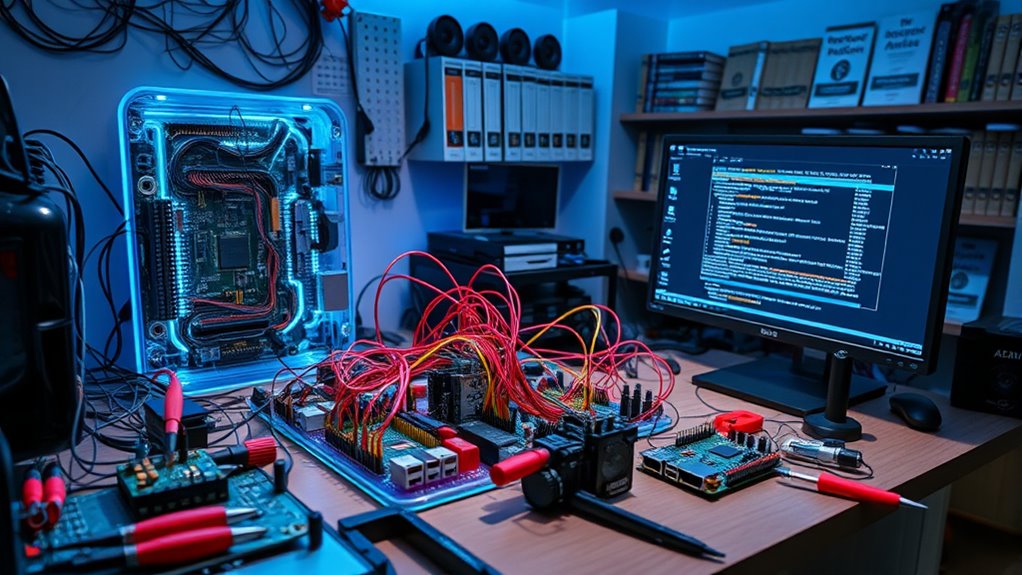
Open-source hardware platforms are transforming the way artificial intelligence develops and deploys by providing accessible, customizable, and cost-effective tools. These platforms empower you to dive deep into chip design, giving you the flexibility to tailor hardware to your specific AI needs. Instead of relying solely on proprietary solutions, you can now participate in the creation and improvement of hardware that directly influences AI performance. This democratization of toolsets lowers barriers, enabling more innovators to experiment with novel architectures, optimize power efficiency, or enhance processing speed. When you engage with open-source hardware, you’re not just a user—you’re part of a broader community dedicated to advancing AI technology through shared knowledge and collective effort.
Community collaboration forms the backbone of open-source hardware platforms. It’s a space where engineers, researchers, hobbyists, and industry leaders come together, exchanging ideas, troubleshooting issues, and refining designs. This collaborative environment accelerates innovation because you can leverage the collective expertise of a global network rather than working in isolation. For example, you might contribute improvements to a chip’s architecture, suggest new features, or adapt existing designs to fit emerging AI workloads. This ongoing feedback loop means hardware evolves rapidly, aligning with the latest AI developments and your specific project requirements. Such collaboration also fosters transparency, allowing you to understand exactly how hardware functions, which is essential for optimizing AI models or ensuring security.
Furthermore, community-driven projects often come with extensive documentation, tutorials, and forums, making it easier for you to learn and participate regardless of your skill level. You can modify existing open-source designs or develop entirely new ones, improving upon previous work and sharing your innovations with others. This ecosystem encourages experimentation, which is indispensable for advancing AI capabilities. As you contribute your insights and improvements, you help build a more robust, versatile hardware infrastructure for AI applications. The spirit of community collaboration also helps standardize interfaces and protocols, simplifying integration across different platforms and tools. Additionally, understanding the off-road top speeds of related technologies can inspire innovations in hardware design that optimize performance under demanding conditions.
Ultimately, the synergy between open-source chip design and community collaboration accelerates AI progress. It shifts the focus from proprietary, expensive hardware to open, adaptable solutions that you can customize and improve. This collective approach not only democratizes access to advanced AI hardware but also guarantees that the technology evolves in ways that meet real-world needs. As more people participate, sharing their innovations and insights, the pace of AI development speeds up, making groundbreaking advancements accessible to a broader audience and fueling the next wave of intelligent systems.

Robotic Arm with Arduino 5DOF/Axis AI Smart Robot Arm Open Source STEM Educational Building Robotics & Engineering Kits, Science/Coding/Programming Set, miniArm Starter Kit
- Open Source Arduino Compatibility: Built on Atmega328 platform with open-source code
- High-Performance Hardware: Includes digital servos, Bluetooth, and expansion ports
- Sensor Expansion Support: Supports ESP32 Cam, accelerometer, touch, ultrasonic sensors
As an affiliate, we earn on qualifying purchases.
As an affiliate, we earn on qualifying purchases.
Frequently Asked Questions
How Do Open-Source Hardware Platforms Impact AI Innovation?
Open-source hardware platforms boost your AI innovation by enabling community collaboration and hardware customization. You can share ideas, improve designs, and adapt hardware to your specific needs quickly. This collaborative environment accelerates development, reduces costs, and fosters creativity. By using open-source options, you stay flexible, experiment more freely, and contribute to a growing ecosystem that pushes AI advancements faster than proprietary solutions.
What Are the Main Challenges in Adopting Open-Source AI Hardware?
Think of adopting open-source AI hardware like building a complex puzzle. You face challenges like component compatibility, where pieces must fit perfectly, and licensing complexities, which can be confusing and restrictive. These issues slow down innovation because you spend extra time troubleshooting and ensuring legal compliance. Overcoming these hurdles requires careful planning and collaboration, but doing so unfastens the true potential of open-source hardware to accelerate AI development.
How Secure Are Open-Source Hardware Platforms Against Cyber Threats?
Open-source hardware platforms can be quite secure, but you should be aware of hardware vulnerabilities that might exist. Since the designs are open, malicious actors can analyze them for weaknesses, making encryption challenges more critical. To protect your systems, you need to regularly update firmware, implement robust security protocols, and stay informed about potential vulnerabilities to mitigate cyber threats effectively.
Can Open-Source Hardware Fully Replace Proprietary AI Solutions?
Open-source hardware can substantially supplement proprietary AI solutions, but it may not fully replace them yet. With community collaboration and hardware customization, open-source platforms offer flexibility and transparency that proprietary options can’t always match. However, for critical applications requiring strict security and optimized performance, proprietary solutions might still be preferred. Ultimately, the choice depends on your specific needs, balancing innovation with reliability.
What Are the Cost Implications of Using Open-Source AI Hardware?
You’ll find open-source AI hardware highly cost-efficient, often reducing expenses by up to 50% compared to proprietary options. With hardware scalability, you can expand your setup as needed without hefty investments, making it perfect for flexible projects. While initial costs are low, consider ongoing maintenance and customization. Overall, open-source solutions offer a budget-friendly way to innovate, giving you more control over your AI infrastructure’s cost and growth potential.

youyeetoo YY3588 AI Single Board Computer – RK3588 SoC with 6TOPS NPU – LPDDR4 32GB RAM Max, 4K/8K Video Codec, Support PCIe 3.0 2280 NVMe/SATA 3.0 SSD for IoT (4g+32g,SBC kit)
- Powerful Octa-Core SoC: RK3588 with Cortex-A76 and A55 cores
- Integrated 6TOPS NPU: Supports AI acceleration and various frameworks
- Multiple RAM Options: Up to 32GB LPDDR4 for high performance
As an affiliate, we earn on qualifying purchases.
As an affiliate, we earn on qualifying purchases.
Conclusion
As open-source hardware platforms for AI grow, you might expect complexity to rise. Instead, you find accessibility and innovation, empowering you to build, customize, and experiment freely. It’s a paradox: advanced technology becomes simpler and more collaborative. By embracing open-source, you’re not just adopting new tools—you’re joining a movement that democratizes AI, turning what once seemed exclusive into something everyone can shape. In this landscape, limits dissolve, and possibilities expand—just like your own potential.

iCESugar-nano FPGA Development Board Open Source RISC-V iCE40LP1k Standard PMOD Connector (iCESugar-nano)
As an affiliate, we earn on qualifying purchases.
As an affiliate, we earn on qualifying purchases.

Radxa Cubie A7A,Edge AI Platform,High-Speed LPDDR5,Single Board Computer (Radxa Cubie A7A 6GB)
- Powerful Computing: High-speed LPDDR5 memory for edge AI
- Versatile Connectivity: Multiple USB ports, HDMI, Ethernet
- Compact Design: Space-efficient circuit board layout
As an affiliate, we earn on qualifying purchases.
As an affiliate, we earn on qualifying purchases.