TL;DR
Moving your rig into a closet or small space can drastically cut noise, but ventilation and placement matter more. Acoustic treatment inside helps with reflections, while sealing gaps reduces sound leaks. The key is balancing quiet with cooling.
If your workspace is filled with the roar of a high-powered AI rig or gaming PC, you’re not alone. Many creators and tech enthusiasts turn to closets and small rooms to hide noisy gear.
But it’s not just about hiding noise—it’s about making the space work for you. You want quiet, yes, but also safe from overheating, with a setup that actually improves sound quality. This guide reveals the secrets behind effective acoustic dampening, smart placement, and how to turn a closet into a functional, silent studio or workstation.
Acoustic dampening
& the rig in the closet.
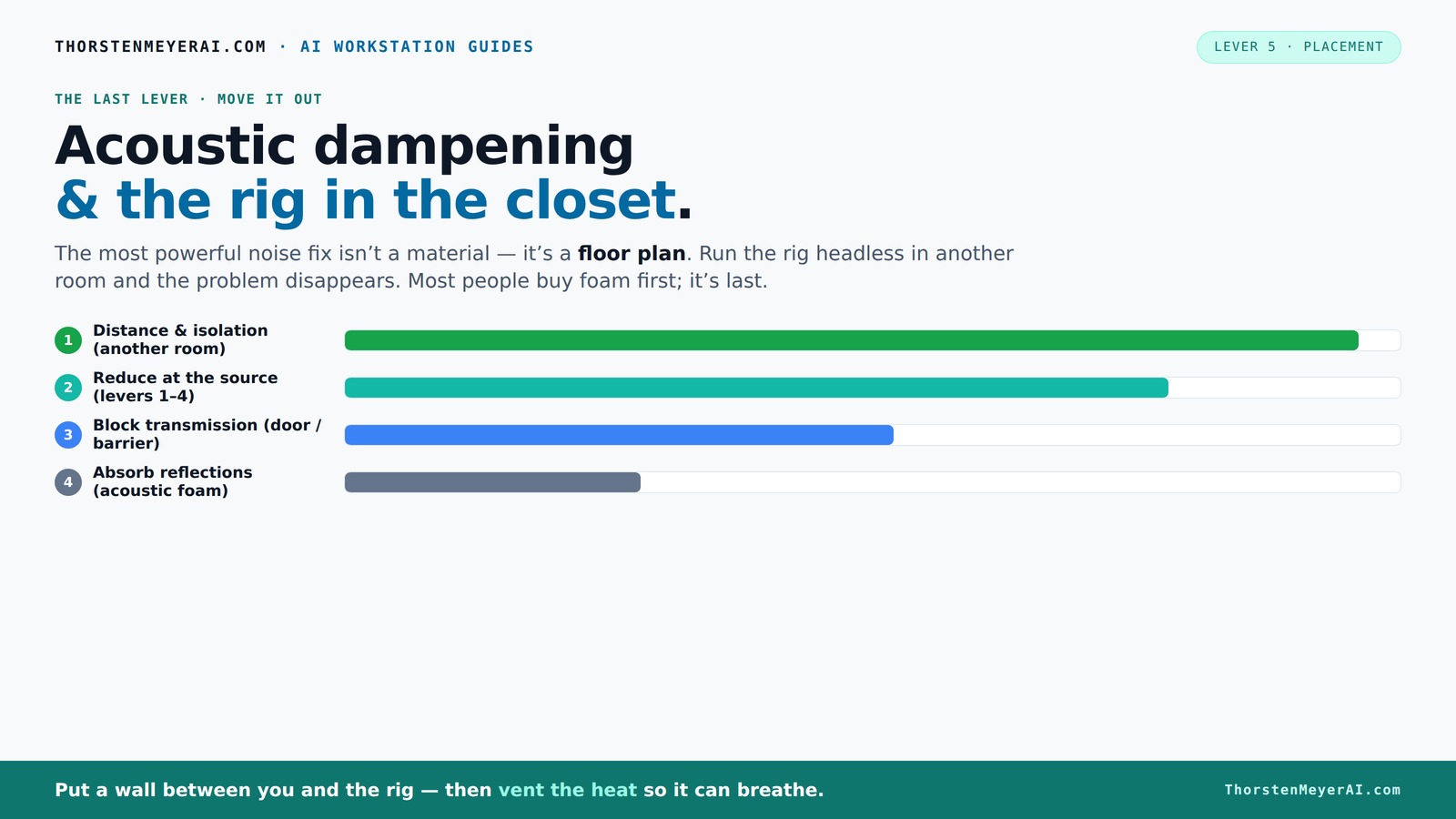
The most powerful noise fix isn’t a material — it’s a floor plan. A rig you can’t hear because it’s in another room beats any amount of foam. Tap the approaches in Part 1 to see what actually works.
(another room)
(levers 1–4)
(door / barrier)
(acoustic foam)
Contain the noise, not the heat
Key Takeaways
- Moving your rig into another room often beats any foam treatment for noise reduction.
- Proper ventilation is essential when placing a hot, powerful machine in a closet—without it, overheating sabotages your efforts.
- Placement of acoustic panels at reflection points drastically improves sound quality inside the space.
- Sealing gaps around doors, outlets, and walls cuts sound leaks by up to 15 dB, making your space much quieter.
- Bass traps in a small closet are mainly for fixing echoes, not soundproofing; use them if low-frequency issues are noticeable.

Focusound 52 Pack Acoustic Foam Panels 1" x 12" x 12" Sound Proof Foam Panles Soundproofing Noise Cancelling Wedge Panels for Home Office Recoding Studio with 300PCS Double-Side Adhesive
Soundproofing - Acoustic foam panels triangular grooves structure for better noise absorption, helps to reduce and absorb unwanted...
As an affiliate, we earn on qualifying purchases.
As an affiliate, we earn on qualifying purchases.
Why Moving Your Rig Is the Easiest Noise Fix (And Why Foam Comes Last)
Putting your machine in another room is the most effective way to cut noise. It’s simple, cheap, and doesn’t require buying a single panel. When your rig's miles away, the sound of fans and GPUs barely reaches you.
Acoustic foam and treatment only soften reflections inside a room. They won’t stop sound from escaping or entering. Think of foam as interior decor—nice, but not a soundproof wall.
For example, if your gaming PC lives in the closet, your desk stays silent while the noise bubbles away behind the door. The only thing you need is a stable wired connection and good airflow.

be quiet! Silent Base 802 ATX Midi Tower PC Case | 3 Pre-Installed Pure Wings 2 Fans | Sound Insulated | Black | BG039
VERSATILITY: Interchangeable top cover and front panel cater to either maximum airflow or silent operation.
As an affiliate, we earn on qualifying purchases.
As an affiliate, we earn on qualifying purchases.
The 'Rig in the Closet' Setup: Why It Works and What to Watch Out For
Placing a loud machine inside a closet is like putting a jet engine in a tiny room. It can work beautifully—if you handle heat properly. The key is ventilation: a vent, a fan, or ducting to move hot air out.
Without airflow, your rig heats up quickly. Trapped heat throttles performance and causes fans to scream louder. You'll need active ventilation—think quiet exhaust fans with thermostats or even ducted systems designed for soundproof cabinets.
For instance, a well-ventilated closet with a quiet fan can keep a 600W GPU rig cool while staying under 40 dB. That’s quieter than a whisper in a library.

Easy Cloud Computer Fan with AC Plug, 120mm Variable Speed Axial Muffin PC Fan with Controller 120V 110V 220V Small 12V Case Cooling for PC Server Cabinet DVR TV Router Receiver Xbox Greenhouse
【Speed Controllable】Easy Cloud axial fan 120v allows you to freely adjust the computer cooling fan speed according to...
As an affiliate, we earn on qualifying purchases.
As an affiliate, we earn on qualifying purchases.
How to Properly Place Acoustic Panels Without Wasting Money
Acoustic dampening isn’t just about slapping foam everywhere. Placement is king. The most effective spots are the first reflection points on side walls, the wall behind your microphone, and the ceiling above your workspace.
Use a mirror trick: sit near your mic and have a friend move a mirror along the wall. Wherever you see the reflection of your speakers or monitor—those are your reflection points.
In a closet, lining the back wall and ceiling with absorption material reduces harsh echoes. For example, a few 2'x4' panels on the side reflecting surfaces can cut echo by up to 50%, making your recordings clearer and more professional.

Weather Stripping Door Seal Strip - Soundproof Q-Shaped Foam for Exterior Door Frame, Large Gap Seal, Noise Cancelling, Easy to Install (Black, 26FT)
No light penetration: Our door seals are made of high-density foam core material, which effectively blocks light from...
As an affiliate, we earn on qualifying purchases.
As an affiliate, we earn on qualifying purchases.
Sealing the Gaps: The hidden key to soundproofing a closet
Sound leaks through cracks, gaps, and loose doors. Sealing them makes a huge difference. Use acoustic sealant around door frames and outlets, add weatherstripping, and consider a heavy blanket or door seal for the closet door.
Imagine sealing every crack like wrapping your closet in a giant, soft blanket that muffles sound. It’s surprising how much sound escapes through tiny openings—sometimes over 20% of the noise.
For example, sealing a closet door with weatherstripping and a draft blocker can reduce sound leakage by 10-15 dB, making your space much quieter.
Bass Traps and Low Frequencies: Are They Necessary in a Closet?
Low-frequency buildup is common in small spaces. Bass traps in corners absorb these problematic waves, preventing the room from sounding boomy or muddy. If your closet sounds hollow or has a 'thumping' bass, adding traps can fix that.
Most small spaces don’t need full bass trap coverage, but placing a few in upper corners can tame low-end issues. For example, a DIY bass trap using mineral wool or rigid fiberglass can reduce bass resonance by over 30%.
According to soundproofing experts, in a tiny closet, bass traps are more about fixing echoes than about blocking sound.
DIY vs. Professional Solutions: What’s Worth Your Time and Money?
DIY treatment with moving blankets, rugs, and foam panels is cost-effective and reversible. It’s perfect for renters or those not wanting to tear into walls. However, for better soundproofing and cooling, investing in purpose-built cabinets or vented enclosures pays off.
For example, a DIY closet booth might cost under $200 in materials and yield a noticeable drop in echo. But if you need serious noise reduction—say, for a professional vocal booth—spending $1,000+ on a soundproof cabinet with active cooling is more reliable.
Pro setups often include custom airflow and insulation, but good DIY strategies can get you 80% there for a fraction of the cost.
Common Mistakes That Sabotage Your Closet Setup
Overusing foam without sealing gaps creates a false sense of security. Foam absorbs reflections but does little to block sound leaks. Also, ignoring door treatment leaves a big hole for sound to escape.
Another mistake: placing the rig directly on a hard surface without vibration isolation—this transmits low-frequency hum and makes the noise worse.
Finally, neglecting ventilation causes overheating, throttling performance and increasing fan noise. Always plan airflow before sealing everything up.
Budget Tiers for Closet Acoustic and Cooling Improvements
Starting small? Use thick moving blankets and door seals for under $50. Add foam panels at reflection points for around $100. These simple fixes dramatically improve sound quality and reduce leaks.
Intermediate upgrades include adding bass traps and venting fans, which can run $200–$500. These make a real difference in controlling low-end and keeping your rig cool.
High-end: custom soundproof cabinets with ducted airflow and active cooling can cost $1,000+ but turn a closet into a professional-grade studio or server room. This layered approach lets you scale as your needs grow.
Frequently Asked Questions
Does acoustic foam soundproof a closet?
No. Acoustic foam mainly reduces reflections and echo inside the space. It doesn’t block sound from escaping or entering. To soundproof effectively, sealing gaps and adding mass are necessary.Where should I place acoustic panels in a closet?
Start with the wall behind your microphone, the side walls facing the speakers, and the ceiling if possible. Use a mirror trick to identify reflection points for best placement.Do I need bass traps in a closet?
Only if the space sounds boomy or has low-frequency resonances. Placing traps in upper corners can tame these issues, but they’re not always necessary for small, well-treated closets.How do I reduce sound leaking out of the closet?
Seal cracks with acoustic sealant, add weatherstripping around doors, and consider a heavy blanket or door seal. For serious reduction, extra drywall or insulation can help if the structure allows.Is a reflection filter enough for vocal recording?
It can help in rental setups, but usually works best as part of a broader treatment plan. Combining it with panels and proper mic placement yields the best results.Conclusion
Turning a closet into a quiet, usable space is about more than just slapping foam on the walls. It’s a careful balance of placement, sealing, and ventilation. When done right, your noisy rig becomes a distant hum, and your workspace transforms into a calm, focused zone.
Remember: good placement and airflow matter more than all the foam in the world. With a little planning and some smart upgrades, your closet can become the perfect hideaway for your tech or vocals—silent, cool, and functional.